How to Protect Your Privacy on Dating Apps
Dating apps collected more user data in 2025 than any previous year. Tinder's parent company Match Group processes data from over 45 million monthly users across its platforms. A Mozilla Foundation study found that 80% of dating apps share or sell user data to third parties. Meanwhile, dating app data breaches have exposed millions of profiles, private messages, and location histories.
You cannot date online without sharing some personal information, but you can control exactly how much you share and who has access to it. This guide covers specific, actionable steps for protecting your privacy on Tinder, Bumble, Hinge, and other major platforms.
Why Dating Apps Are Privacy Nightmares
Dating apps know more about you than most other apps on your phone. They collect:
- Location data: Your precise GPS coordinates, updated in real time while the app is open
- Behavioral patterns: Who you swipe on, how long you look at each profile, your messaging patterns
- Photos: Often with EXIF metadata that includes camera model, date, and location where the photo was taken
- Phone number: Used for verification and cross-referenced with other data
- Social connections: If you sign up with Facebook or link Instagram, they access your social graph
- Device data: Phone model, OS version, carrier, IP address, advertising identifiers
This data has real consequences. In 2023, a Grindr data breach exposed the precise locations of users, including people in countries where being gay is illegal. Tinder profiles have been scraped and used to create facial recognition databases without consent. Private messages have been leaked in multiple breaches.
Step 1: Use a Virtual Number for Sign-Up
Every major dating app requires phone verification during sign-up. Your phone number is one of the most valuable pieces of identifying data because it ties your dating profile to your real identity through reverse phone lookups and data broker databases.
🔒 Need a virtual number right now?
Instant SMS verification • 150+ countries • from $0.20
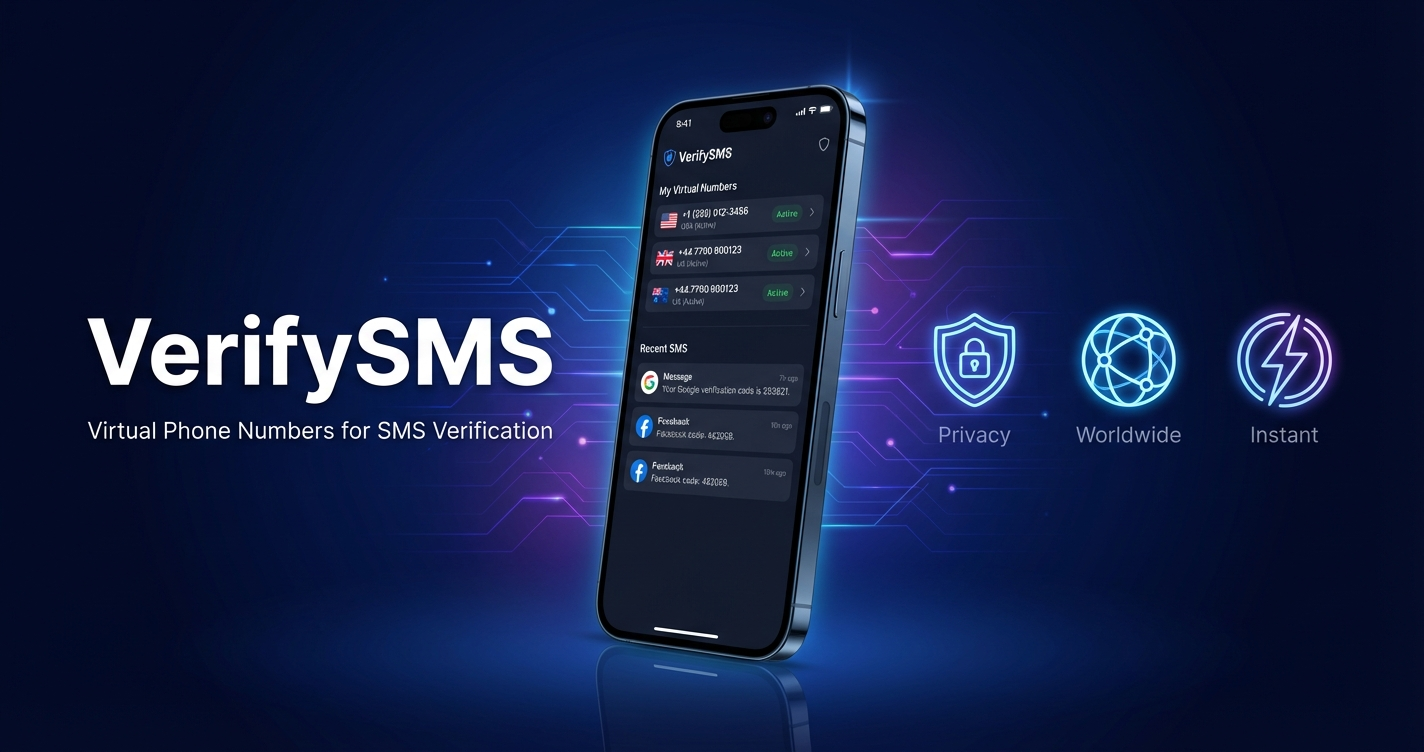
📱 Download VerifySMS FreeInstead of using your real number, verify with a temporary phone number from VerifySMS. The process takes under a minute:
- Open VerifySMS and select the country for your number
- Start the dating app sign-up process
- Enter the VerifySMS number when prompted
- Receive the verification code in the VerifySMS app
- Enter the code in the dating app
This single step prevents your dating profile from being linked to your real phone number. Even if the app gets breached, the leaked number is disposable and reveals nothing about you.
Compatibility by App
| Dating App | Virtual Number Works? | Notes |
|---|---|---|
| Tinder | Yes | SMS verification supported |
| Bumble | Yes | Phone number verification |
| Hinge | Yes | Phone number required |
| OkCupid | Yes | Phone or email verification |
| Grindr | Yes | Phone number required |
| Coffee Meets Bagel | Yes | Phone number required |
Step 2: Create a Dedicated Email Address
Do not use your primary email to sign up for dating apps. Your primary email is likely connected to your social media, work accounts, and financial services. If a dating app breach exposes your email, attackers can cross-reference it across other databases.
Create a dedicated email address that you use only for dating. Use a privacy-focused provider like ProtonMail, or create a simple Gmail alias. Do not include your real name in the email address.
Step 3: Lock Down Your Profile Information
The information in your dating profile is semi-public. Anyone you match with, and in some apps anyone who sees your profile, can view it. Treat it accordingly.
🔒 Need a virtual number right now?
Instant SMS verification • 150+ countries • from $0.20
📱 Download VerifySMS FreePhotos
- Strip EXIF data from photos before uploading (most photo editors can do this)
- Avoid photos that show your home, workplace, license plate, or street address
- Do not use the same photos on dating profiles and your public social media (reverse image search links them)
- Consider using photos that are not on any other platform to prevent cross-referencing
Bio and Personal Details
- Do not include your last name
- Be vague about your employer (say "tech industry" instead of "software engineer at Google")
- Avoid sharing your specific neighborhood. City-level is sufficient.
- Do not link Instagram, Spotify, or other social accounts
Step 4: Manage Location Permissions
Dating apps need location to show you nearby matches. They do not need it running 24/7.
- iOS: Set location permission to "While Using" instead of "Always." Better yet, use "Ask Next Time" and grant it only when actively swiping.
- Android: Same approach. Go to Settings > Apps > [Dating App] > Permissions > Location > "Only while using the app."
Some apps like Bumble and Hinge let you set a general location without using GPS. Use this option when available. It prevents the app from tracking your exact movements while still showing you relevant matches.
Step 5: Secure Your Conversations
Messages within dating apps are stored on the company's servers. They are not end-to-end encrypted on most platforms. Assume anything you type in a dating app can be read by employees or leaked in a breach.
🔒 Need a virtual number right now?
Instant SMS verification • 150+ countries • from $0.20
📱 Download VerifySMS FreeFor conversations that are becoming more personal:
- Move to an encrypted messaging app like Signal before sharing sensitive details
- Use your virtual number or a burner number for communication outside the dating app
- Do not share your real phone number until you have met in person and feel comfortable
- Never send financial information, government IDs, or explicit photos with identifying features through dating app messages
Step 6: Handle the Transition to Real Communication
At some point, you will want to move off the dating app and communicate directly with someone. This is where many people give up all their privacy gains by sharing their real number too early.
A better approach:
- Move to Signal or WhatsApp using a virtual number first
- Communicate for a few weeks to build trust
- Meet in person in a public place
- Share your real number only after you have established genuine trust
This layered approach costs almost nothing (a virtual number is under $1) but gives you a clear exit strategy if things go wrong. You can discard the virtual number without any disruption to your real life.
App-Specific Privacy Settings
Tinder
- Go to Settings > Privacy > disable "Personalised Ads"
- Turn off "Show Me on Tinder" when not actively looking
- Do not connect Instagram or Spotify
- Use the "Hide My Age" and "Hide My Distance" options in Tinder Plus/Gold
Bumble
- Enable "Snooze Mode" when taking breaks instead of keeping the profile active
- Do not enable "Verified" badge if it requires sharing additional personal data
- Disable location when not swiping
Hinge
- Limit the prompts that reveal identifiable information
- Do not connect social accounts
- Use the "Pause" feature during breaks
What to Do If Something Goes Wrong
If you encounter harassment, stalking, or feel unsafe:
- Block and report the person immediately within the app
- Screenshot everything before blocking, in case you need evidence later
- If using a virtual number, discard it and the person loses all ability to contact you
- Report to local authorities if threats are involved
- Google yourself to see what a determined person could find. Remove what you can.
Having used a virtual number and a dedicated email from the start means a bad actor has almost no path to your real identity. This is the core advantage of setting up privacy layers before you need them, not after.
Data Broker Removal for Dating App Users
Even with all the above precautions, your existing data broker profiles may already link your real phone number, name, and address. A determined person who finds your dating profile could use any identifying detail (first name, neighborhood, workplace) to look you up on people-search sites.
Take these additional steps to reduce your exposure:
- Search for yourself: Google your name plus city, and check people-search sites like Spokeo, BeenVerified, WhitePages, and Radaris
- Submit removal requests: Each data broker has a removal/opt-out process. It takes 10-30 minutes per site, and removals typically process within 30 days
- Use a removal service: Paid services like DeleteMe or Kanary automate the opt-out process across dozens of data brokers. Costs $100-200/year.
- Repeat quarterly: Data brokers re-acquire your information from public records. Removal is not permanent, so periodic re-submission is necessary.
This step pairs with using a virtual number for dating apps. Even if someone reverse-searches your virtual number, they find nothing. And if they try to search your name, the data broker cleanup ensures the trail runs cold.
Privacy Is Not Paranoia
Protecting your privacy on dating apps is not about being suspicious of every match. It is about maintaining control over your personal information in a system that is designed to collect and monetize as much of it as possible.
The total cost of these privacy measures is minimal: a virtual number for under $1, a free email address, and 10 minutes adjusting app settings. The protection they provide against data breaches, stalking, identity theft, and spam is significant.
Start with the highest-impact step: get a virtual number for your next dating app sign-up. Everything else builds on that foundation.
Related Articles
- How to Get a Virtual Phone Number
- Verify WhatsApp Without Phone Number
- What Is a Temporary Phone Number?
Ready to protect your privacy?
Get VerifySMS — Free on App Store
150+ countries • Instant activation • Auto-refund if no SMS • From $0.20
Download Free App★★★★★ 4.8 • iOS 16+ • Free