How to Safely Create Anonymous Online Accounts
Every online account you create is a data point. Your email, phone number, IP address, device fingerprint, and behavioral patterns all combine into a profile that follows you across the internet. If you want to create accounts that cannot be easily traced back to your real identity, you need a strategy that addresses each of these vectors.
This is not about doing anything illegal. Journalists protecting sources, activists in hostile environments, domestic abuse survivors avoiding stalkers, security researchers testing systems, and privacy-conscious individuals all have legitimate reasons to maintain anonymous online identities. This guide covers the practical steps.
The Three Pillars of Account Anonymity
Anonymous account creation rests on three foundations. Neglect any one of them and the chain breaks:
- Anonymous contact information — Email and phone number that are not linked to your real identity.
- Network anonymity — IP address and connection metadata that do not point back to you.
- Device and behavioral isolation — Browser fingerprint, device identifiers, and usage patterns that are not shared with your real accounts.
Most people focus only on the first pillar and ignore the other two. An anonymous email means nothing if you sign up from your home IP address with your regular browser that has cookies from your real Gmail account.
Pillar 1: Anonymous Email
You need an email address that is not connected to your identity. Here are your options, ranked by privacy level:
🔒 Need a virtual number right now?
Instant SMS verification • 150+ countries • from $0.20
📱 Download VerifySMS FreeTier 1: Privacy-focused email providers
- ProtonMail — Swiss-based, end-to-end encrypted, allows signup without a phone number (though it may require one during periods of high abuse). Free tier available.
- Tutanota (now Tuta) — German-based, encrypted, no phone number required for signup. Free tier available.
- Disroot — Community-run, no phone number required, no tracking.
Tier 2: Disposable email services
- Guerrilla Mail — Temporary inbox, no signup needed. Good for one-off verifications but emails are deleted after one hour.
- SimpleLogin / AnonAddy — Email aliasing services that forward to your real inbox without revealing it. Not fully anonymous (they know your real email) but good for compartmentalization.
What to avoid
Gmail, Outlook, and Yahoo all require phone verification for new accounts and aggressively track user identity. Even if you manage to create one without a phone number, Google and Microsoft link accounts through device fingerprinting and IP correlation.
Best practice: Create a ProtonMail or Tuta account over a VPN (see Pillar 2) specifically for your anonymous accounts. Never access this email from your regular browser or network.
Pillar 2: Phone Verification Without Identity
Most platforms now require phone verification. This is the point where anonymity typically breaks down, because phone numbers are tied to carrier accounts with your real name and address. Virtual numbers solve this problem.
Why virtual numbers work for anonymity
- No carrier contract with your name attached.
- No physical SIM card tied to a location.
- Numbers are temporary and rotate between users.
- Payment can be made with cryptocurrency or privacy-preserving methods on some services.
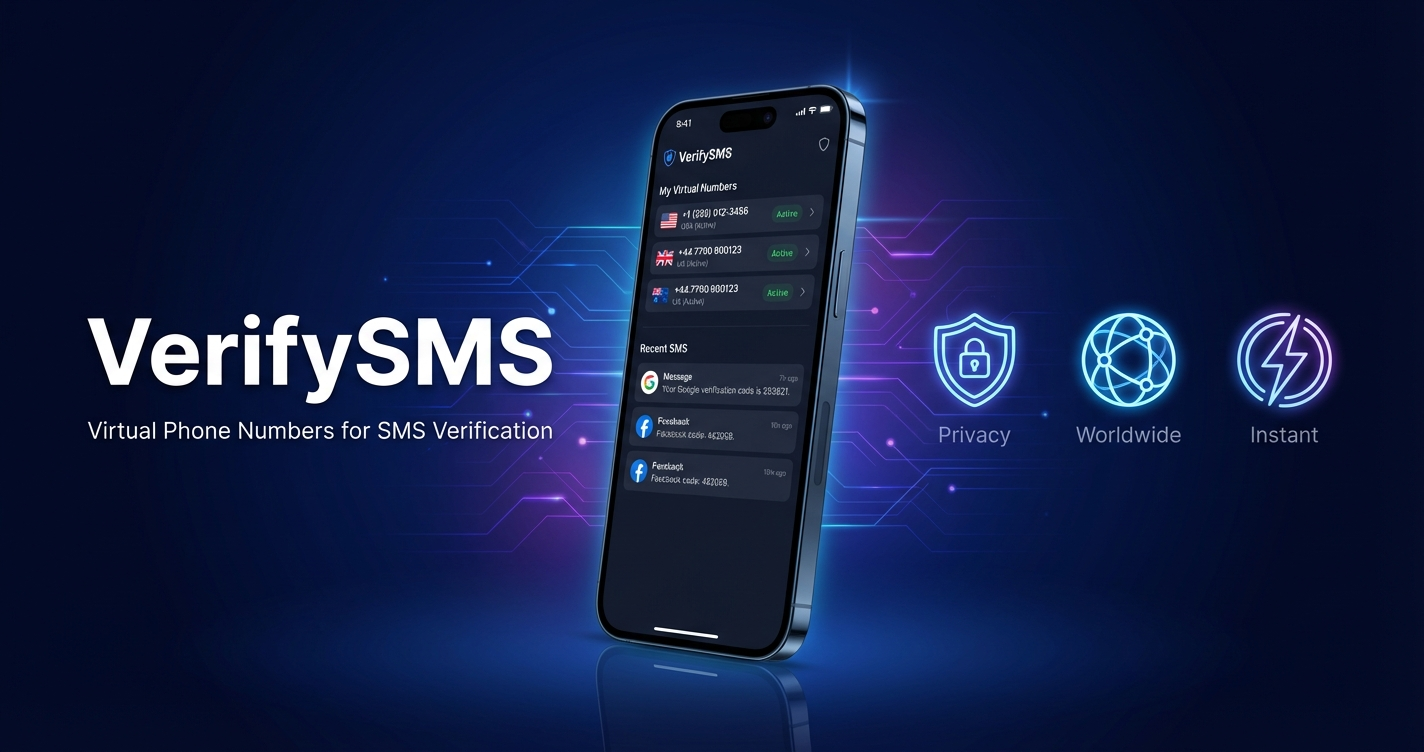
Using VerifySMS for anonymous verification
- Create a VerifySMS account using your anonymous email (from Pillar 1).
- Add credits to your balance.
- When a platform asks for phone verification, select the service and country in the VerifySMS app.
- Activate a number, enter it on the platform, receive the SMS code, verify.
- The number returns to the pool after use — no ongoing connection to you.
For a detailed walkthrough of the app, see our complete beginner's guide to VerifySMS.
Virtual numbers vs. other options
| Method | Anonymity Level | Cost | Practical for Multiple Accounts |
|---|---|---|---|
| Virtual number (VerifySMS) | High | $0.10-$0.50 per verification | Yes |
| Prepaid SIM (cash purchase) | Medium-High (depends on country ID requirements) | $5-$20 per SIM | Expensive at scale |
| Google Voice | Low (tied to Google account) | Free | No (one number per account) |
| Free SMS websites | None (numbers are public) | Free | Unreliable |
| Borrowed phone | Low (involves another person) | Free | No |
🔒 Need a virtual number now?
🔒 Need a virtual number right now?
Instant SMS verification • 150+ countries • from $0.20
📱 Download VerifySMS Free150+ countries · Instant activation · $0.10/number
Pillar 3: Network Anonymity (VPN and Tor)
Your IP address reveals your approximate location and internet service provider. Every website you visit sees it. To create accounts anonymously, you need to mask it.
VPN (Virtual Private Network)
A VPN routes your traffic through a server in another location, replacing your IP address with the VPN server's IP. For anonymous account creation:
- Choose a VPN provider with a strict no-logs policy. Look for providers that have been audited by independent third parties.
- Pay for the VPN with a method that does not reveal your identity (cryptocurrency, cash-purchased gift card).
- Use a VPN server in the same country as your virtual phone number and the intended account region. Mismatched signals (US phone number, Brazilian IP, UK email) can trigger security reviews.
- Avoid free VPNs. They monetize through data collection, which defeats the purpose.
Tor Browser
Tor routes your traffic through three encrypted relays, providing stronger anonymity than a VPN. However:
- Many platforms block or heavily restrict accounts created from Tor exit nodes.
- Tor is significantly slower than a VPN, which makes it impractical for ongoing account use.
- Tor provides anonymity but not necessarily privacy from the sites you visit — they still see your activity, just not your real IP.
Practical recommendation: Use a VPN for account creation and normal use. Reserve Tor for situations where the VPN provider itself is a threat model concern.
🔒 Need a virtual number right now?
Instant SMS verification • 150+ countries • from $0.20
📱 Download VerifySMS FreeBrowser Isolation and Fingerprinting
Your browser leaks identity through fingerprinting: screen resolution, installed fonts, browser plugins, timezone, language settings, canvas rendering, WebGL capabilities, and dozens of other signals. Together, these create a unique fingerprint that can track you across sites even without cookies.
Browser compartmentalization strategy
- Dedicated browser profile — Use a separate browser profile (or a separate browser entirely) for your anonymous accounts. Never log into your real accounts from this browser.
- Firefox with privacy extensions — Firefox with uBlock Origin, Privacy Badger, and Canvas Blocker provides good fingerprint resistance. Set
privacy.resistFingerprintingtotrueinabout:config. - Brave Browser — Has built-in fingerprint randomization and ad blocking. Practical for daily use with decent privacy.
- Mullvad Browser — Built on Firefox ESR by the Tor Project team, specifically designed to minimize fingerprinting. All users have the same fingerprint, making individual tracking difficult.
What to avoid
- Chrome with your Google account signed in. Google correlates everything.
- Browser extensions that are unique to you (rare extensions make your fingerprint more identifiable).
- Logging into any real-identity account from your anonymous browser. One slip connects everything.
Operational Security (OPSEC) Basics
Technical measures fail if your behavior gives you away. OPSEC is the discipline of not accidentally revealing your identity through patterns and habits.
The separation rule
Never mix your anonymous identity with your real identity. This means:
- Do not access anonymous accounts from your home network without a VPN.
- Do not reference personal details, locations, or experiences that could identify you.
- Do not reuse usernames, passwords, or writing styles across identities.
- Do not upload photos that contain EXIF metadata (location, camera model, timestamp).
Timing patterns
Your activity schedule can identify you. If your anonymous account is always active during your timezone's waking hours and goes silent during your sleep hours, that narrows down your location. For high-security needs, vary your activity times.
Writing style
Stylometry — analysis of writing patterns — can link anonymous accounts to known identities. For most use cases, this is not a realistic threat. But if you are a public writer or blogger, be aware that your sentence structure, vocabulary choices, and punctuation habits are identifiable.
Payment isolation
If your anonymous account requires payment (for premium features, for example), use a method that does not connect to your real identity:
- Cryptocurrency purchased through a privacy-preserving method.
- Prepaid gift cards purchased with cash.
- Virtual credit card services (though many still require identity verification).
Platform-Specific Tips
Social media (Facebook, Instagram, TikTok, X)
- These platforms use device fingerprinting aggressively. A dedicated device or virtual machine is ideal.
- Avoid connecting to other accounts, even indirectly (do not follow your real account from your anonymous one).
- Disable contact syncing immediately after account creation.
- Each platform needs its own virtual number for verification. See our platform-specific guides for Facebook, Instagram, and TikTok.
Messaging apps (WhatsApp, Telegram, Signal)
- WhatsApp requires an active phone number for the lifetime of the account. A virtual number works for initial verification but you may lose access if the number rotates.
- Telegram allows signup with a virtual number and does not require ongoing SMS access after initial setup.
- Signal requires a phone number but recently introduced username-based communication, reducing the need to share your number.
Email-only services (Reddit, forums)
- Many forums and Reddit allow email-only registration with no phone verification.
- Use your anonymous email from Pillar 1.
- Be extra cautious about writing style on text-heavy platforms where stylometry is more effective.
For a general guide to verifying any app without your real number, see how to verify any app without your real phone number.
Common Mistakes That Break Anonymity
- Forgetting the VPN once — One login from your real IP can permanently link the account to your identity. Use a VPN kill switch.
- Cross-account contact sharing — Uploading your real phone contacts to an anonymous account. Platforms use mutual contacts for identity resolution.
- Same password across identities — If one account is compromised, password reuse links it to others. Use a separate password manager for anonymous accounts.
- Photo metadata — Posting photos with EXIF data intact. Strip metadata before uploading. Most platforms strip it automatically, but do not rely on this.
- Recovery email/phone — Setting your real email or phone as the recovery option for an anonymous account. Use your anonymous email for recovery.
- Consistent timing — Always being active at the same hours across real and anonymous accounts. This correlation is used by advanced adversaries.
- Talking about it — The most common OPSEC failure. Telling people about your anonymous account, even trusted people, creates a link.
Threat Model: How Much Anonymity Do You Need?
| Threat Level | Who | What You Need |
|---|---|---|
| Low (casual privacy) | Advertisers, data brokers, nosy acquaintances | Anonymous email + virtual number + VPN |
| Medium (targeted harassment, doxxing risk) | Online stalkers, ex-partners, internet mobs | Above + browser isolation + OPSEC discipline + separate device |
| High (journalist, activist, whistleblower) | Corporations, governments, sophisticated adversaries | Above + Tor + dedicated hardware + physical security + legal counsel |
Most people reading this guide fall into the Low or Medium category. The steps in this guide cover both. If you are in the High category, this guide is a starting point, not a complete solution — consult resources from the Electronic Frontier Foundation (EFF) or Committee to Protect Journalists (CPJ) for situation-specific guidance.
Summary
Creating anonymous online accounts requires addressing three vectors: contact information (anonymous email + virtual phone number), network identity (VPN or Tor), and device fingerprinting (browser isolation). The practical setup takes about 30 minutes: create a ProtonMail account over a VPN, set up VerifySMS with that email, configure a dedicated browser profile, and you are ready to create accounts that are not linked to your real identity. The weakest link is always human behavior — OPSEC discipline matters more than any tool.
Related Articles
Ready to protect your privacy?
Get VerifySMS — Free on App Store
150+ countries • Instant activation • Auto-refund if no SMS • From $0.20
Download Free App★★★★★ 4.8 • iOS 16+ • Free