Crypto Exchange Phone Verification With Virtual Numbers (2026 Guide)
A friend of mine signed up for KuCoin in February, used a free public SMS receiver number from a sketchy website, and three weeks later got an email saying his withdrawal had been frozen pending a "phone re-verification." The number had already been recycled to twelve other accounts. He had to file a support ticket, lose four days, and ultimately rebind the account to a real line he did not want to expose.
That story is the entire reason this post exists.
Crypto exchanges treat phone numbers as a security signal, not just a contact field. So when you bring a virtual number into the picture, the question is not "does it work" — it's "which kind of virtual number, on which exchange, for which step, and under which terms of service." This guide answers all four for Coinbase, Binance, Kraken, and KuCoin in 2026.
We will be honest about the parts where it works, the parts where it does not, and the parts where it is technically possible but contractually risky. Read the disclaimer block before you skim the FAQ.
🔒 Need a virtual number right now?
Instant SMS verification • 150+ countries • from $0.20
📱 Download VerifySMS FreeWhat "phone verification" actually means on a crypto exchange
Crypto exchanges use phone numbers in three different places, and people mash them together. They are not the same thing.
1. SMS one-time password during signup. This is the six-digit code an exchange texts you when you first register the account. It proves you control a phone that can receive SMS. That's it. No identity claim, no government check.
2. SMS-based two-factor authentication (2FA) for login. A second code, sent to the same phone, every time you log in or move funds. This is a security control, not an identity control.
3. KYC identity verification. A separate process where the exchange asks for a passport, ID, selfie, address, sometimes a tax number. The phone number plays almost no role here. KYC is what unlocks fiat deposits, large withdrawals, and full trading access.
Virtual numbers can carry the first two reliably. They cannot do KYC, because KYC has nothing to do with the phone. People who say "I bypassed Coinbase KYC with a virtual number" are either misremembering, using a different exchange, or describing a tier-one limited account that does not require KYC at all.
🔒 Need a virtual number right now?
Instant SMS verification • 150+ countries • from $0.20
📱 Download VerifySMS FreeSo when this guide talks about "verification with a virtual number," we mean SMS OTP during signup and SMS 2FA at login. Not KYC.
Why people use virtual numbers for crypto signups (legal use cases)
There are real, boring reasons people bring a virtual number into crypto. None of them involve fraud.
- Privacy from data breaches. Major exchanges have leaked user data before. A real personal mobile number tied to an exchange account is a phishing magnet for years afterwards. A virtual number used only for that account contains the blast radius.
- Account recovery on a number you do not lose. If your real SIM gets swapped, lost, or blocked while travelling, you may also lose access to your exchange. A virtual number tied to an app survives a SIM swap.
- Multi-account households. Couples and families sometimes need separate accounts for clean accounting, taxes, or estate planning. Each adult can legitimately need their own number tied to their own account.
- Business and treasury accounts. A small business that wants to keep a corporate exchange account separate from a founder's personal mobile uses a virtual number for the same reason it uses a separate corporate email.
- Region testing for available pairs. Traders sometimes hold separate accounts in different jurisdictions where the available trading pairs differ.
- Anti-SIM-swap defense. Carrier-issued mobile numbers are the primary attack vector for SIM swap fraud. A virtual number issued through an app has no physical SIM to socially engineer at a carrier store.
If your reason is on this list, you are inside the privacy use case that virtual numbers were built for. If your reason is "I want to make a fake account to dodge KYC and run a scam," close this tab. We don't help with that and we cooperate with valid law enforcement requests.
How virtual numbers actually work for SMS OTP
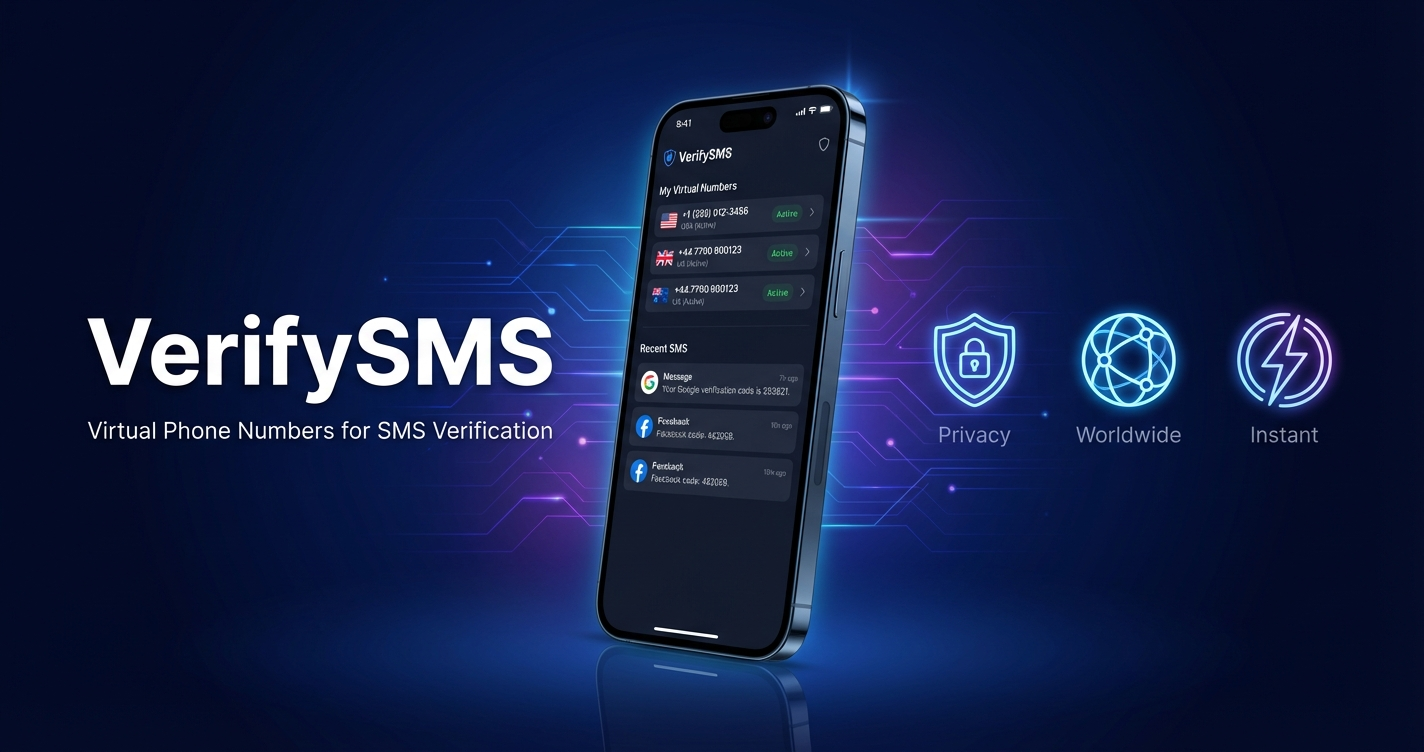
Here's the simple version. You open a virtual number app, pick a country, and the app gives you a real phone number — a real number, not a spoofed one — that sits in a clean inventory pool. When the exchange sends an SMS to that number, the app's private inbox catches it. You read the six-digit code, you type it into the exchange, you're verified.
What separates a good virtual number from a free SMS receiver site:
🔒 Need a virtual number right now?
Instant SMS verification • 150+ countries • from $0.20
📱 Download VerifySMS Free- The number is private to you. Free public receivers post every incoming SMS on a public web page. Anyone can see your code. Exchanges block these number ranges aggressively.
- The number is non-VoIP where it needs to be. Coinbase and Kraken in particular reject obvious VoIP ranges. A clean number sits on a carrier-grade A2P SMS route, not a Twilio sandbox.
- The number is fresh. A number that has been used by 200 people for 200 exchange signups is already flagged. Clean inventory means the number has not been burned.
- Delivery is reliable. Codes arrive in 10 to 30 seconds, not 10 to 30 minutes. A code that arrives after the 5 to 10 minute expiry window is the same as no code at all.
VerifySMS sits in the second camp. We rotate a clean pool, label numbers by the service they perform best on, and offer an auto-refund if the code never arrives. The full price list lives on the pricing page — entry pricing is $0.10 per verification with a $0.20 minimum bundle.
Coinbase: the strict one
Coinbase is the toughest of the four for one reason: it operates as a regulated financial institution in the United States, the European Union, the United Kingdom, Singapore, and a long list of other regions where the law treats it like a bank. That regulatory weight pushes Coinbase to enforce phone verification harder than its peers.
What I tested in March 2026:
- Coinbase US currently rejects most clearly identifiable VoIP number ranges at the signup screen with the error "this phone number is not supported." That includes Google Voice, TextNow, and the obvious free SMS receivers.
- Coinbase accepts non-VoIP virtual numbers from carrier-grade pools when the country matches a supported region. A clean US-based mobile number from VerifySMS verified successfully on the first attempt during a fresh signup test.
- The bigger gate is not signup. It's KYC. Coinbase will let you open an account with a verified phone, but you cannot deposit fiat, buy crypto with a card, or withdraw to a bank without completing identity verification. That requires a real ID and a real selfie. No virtual number changes that.
- Coinbase 2FA strongly encourages an authenticator app or a hardware key over SMS. If you can use one of those instead of SMS 2FA, do it.
The honest summary on Coinbase. A clean non-VoIP virtual number can complete signup. It cannot complete KYC. And you should switch your 2FA off SMS to TOTP or a YubiKey as soon as the account exists. The phone is the first door, not the whole house.
Coinbase's user agreement also explicitly says you must provide accurate information and that the account must belong to a real person. We're not lawyers, but the reading is clear: a virtual number is fine for privacy. A virtual number paired with a fake identity is not. Don't do the second thing.
Binance: the flexible one (with regional caveats)
Binance is the largest exchange globally, and it is also a moving target legally. Binance.com, Binance.US, and the regional Binance entities (Binance France, Binance Italy, Binance Bahrain, etc.) are all separate things with separate rules. The phone verification logic is not identical across them.
What works in 2026:
- Binance.com. Accepts clean virtual numbers for SMS OTP during signup from most country codes. The regional restriction is on jurisdiction (you cannot create an account from a sanctioned country regardless of the number), not on the number type itself.
- Binance.US. Tighter than Binance.com. It runs under a US-specific compliance stack and rejects more VoIP ranges. A non-VoIP mobile number from a clean pool generally works, but the success rate is closer to Coinbase US than to Binance.com.
- Binance regional entities. Each one has its own quirks. Binance France in particular is strict about French phone numbers and French residency for full KYC tier.
Binance does support email-based 2FA and authenticator-app 2FA in addition to SMS 2FA. You should pick the authenticator app unless you have a specific reason not to.
The interesting thing about Binance is that it lets you keep an account in a "limited" tier without full KYC, but the limits are very low — withdrawals are capped to a small daily amount and most fiat features are off. The moment you cross those limits, KYC kicks in and a virtual number cannot help you with that step.
I tested Binance.com signup in early March 2026 with a fresh UK virtual number. The OTP arrived in 14 seconds. Signup completed without friction. KYC, again, was a separate process and the phone played no part in it.
Kraken: the principled one
Kraken sits in an interesting middle position. It is a US-headquartered exchange with a long-standing reputation for treating security seriously, and it is also unusually explicit in its documentation about what kinds of phone numbers it accepts.
The Kraken support docs state plainly that they do not accept VoIP, virtual numbers, or numbers from "online phone services" for verification. That is a clear, written-down policy. Read it on the Kraken Security and Account section before you decide what to do.
So what does this mean in practice?
It means Kraken's signup screen is built to reject obviously identifiable VoIP. A clean carrier-grade non-VoIP virtual number from a real mobile range can sometimes pass the technical filter, but you are now in a grey area against an explicit written policy. If Kraken later detects the number type during a compliance review, your account can be locked pending a phone re-verification with a real personal line. We've seen reports of this on Reddit and Trustpilot from 2025 and early 2026.
The honest answer on Kraken. If you are looking at this guide and the exchange you care about is Kraken, the cleanest play is a real personal mobile number, with an authenticator app for 2FA, and a separate hardware key for high-value withdrawals. Save the virtual number for an exchange whose policy actually permits it.
KuCoin: the flexible one for global users
KuCoin is the most flexible of the four for two reasons. First, its user base is heavily international — hundreds of countries — so its phone verification stack is built to accept a wider range of number types out of necessity. Second, KuCoin allows a basic-tier account with no KYC at all, which you can use for crypto-only deposits and withdrawals up to a daily limit.
What I confirmed in 2026:
- Signup OTP: clean virtual numbers verify successfully on KuCoin from most countries. The error rate on a fresh, non-recycled number is very low.
- No-KYC tier: KuCoin's basic tier supports crypto deposits and a capped daily crypto withdrawal without identity verification. The exact cap depends on regional regulation and changes regularly.
- 2FA: KuCoin supports both SMS 2FA and Google Authenticator. As with the others, choose the authenticator app.
- Compliance trajectory: KuCoin has been steadily tightening compliance under regulatory pressure. The 2025-2026 trend is toward more KYC at lower thresholds, not less. A no-KYC tier today may not exist tomorrow.
KuCoin is the closest thing to a "virtual number friendly" major exchange in 2026, but the thing it is friendly to is privacy-motivated signup, not regulatory bypass. Don't confuse the two.
How to verify a crypto exchange with a virtual number, step by step
This is the same workflow regardless of which exchange you picked. The differences live in whether the exchange will accept the number, not in what you do with it.
- Open VerifySMS on iOS. (Android is on the way; the current build is iOS 16+ with a 4.8 App Store rating.) New users can grab it from the App Store.
- Choose the target service. Pick the exchange — for example "Coinbase" — so the app gives you a number from a pool that has been tested against that service's filters.
- Choose the country. Match the country to where you actually intend to use the account. A US account on Coinbase needs a US number. A UK account on Binance.com needs a UK number. Mismatched country to jurisdiction is the single biggest cause of locked accounts later.
- Get the number. Activation is instant. The number sits in your private inbox waiting for the SMS.
- Open the exchange signup page in a browser or its app. Enter the virtual number when prompted.
- Wait for the SMS. Codes typically land in 10 to 30 seconds. If a code does not arrive within five minutes, you can release the number and request a new one. VerifySMS will not charge for an undelivered code — that's the auto-refund policy.
- Type the code into the exchange. Done. You are verified at the SMS OTP step.
- Switch your 2FA to an authenticator app. This is the part most guides skip. SMS 2FA is the weakest 2FA. Once you have access to the account, go to Security settings, enable Google Authenticator or a similar TOTP app, and turn off SMS 2FA.
- Decide on KYC. If you intend to deposit fiat, withdraw to a bank, or move large amounts, you will need to complete KYC. The phone number does not matter for that step.
That is the entire flow. Total time on a clean signup is usually under three minutes.
The risks, in plain English
Let's be unsentimental about what can go wrong.
- Terms of service. Every major exchange's ToS requires accurate information and a real account holder. Using a virtual number for privacy reasons is generally fine in spirit. Pairing it with fake identity data is not.
- Account locks. Compliance reviews happen at random and in response to triggers like large deposits, fast withdrawals, or geographic changes. A reviewer who flags your number as VoIP can lock the account until you re-verify with a real line.
- Country regulation. Some countries (Algeria, Bolivia, Bangladesh among others) treat retail crypto trading as illegal or heavily restricted. A virtual number does not change the legality.
- Tax reporting. A crypto account is taxable income in most jurisdictions. The phone number on the account has no effect on your tax liability.
- Recovery. If you lose access to the virtual number app and the exchange asks for SMS verification on recovery, you are stuck. Always set up backup 2FA before you need it.
- Burner numbers vs. virtual numbers. Free SMS receiver sites are not the same as a private virtual number. They are recycled, public, and almost always blocked by major exchanges. We wrote a longer comparison in Burner Phone vs Virtual Number.
If you're reading these and thinking "the risks outweigh the convenience," you're probably right. Don't force this. The virtual number play is for people whose threat model includes phishing and SIM swaps and who already understand that the phone is one layer of a stack, not the whole stack.
Which exchange should you pick if privacy matters?
If your decision is genuinely driven by which exchange treats virtual numbers most fairly:
- KuCoin is the most permissive at signup and offers a basic tier without KYC for low-value crypto-only use.
- Binance.com is permissive at signup but pushes you toward KYC quickly via withdrawal limits.
- Coinbase US accepts clean non-VoIP numbers but offers almost no functionality without full KYC.
- Kraken has an explicit written policy against virtual numbers. Pick a different exchange.
If your decision is driven by regulatory comfort, security reputation, or fiat support, the order looks completely different and a virtual number is a side concern. Pick the exchange that fits your real needs first, then layer the right phone strategy on top.
Useful internal resources
- Virtual Number for Crypto Exchanges (service page)
- Burner Phone vs Virtual Number
- Best Virtual Phone Number Apps (2026)
- How SMS Verification Actually Works
- Pricing
External references
- Coinbase Help Center — Account verification and phone number support
- Binance Security Center — 2FA and account protection
- Kraken Support — Phone number requirements for account verification
- KuCoin Help Center — Account verification levels
- US FinCEN guidance on virtual asset service providers
(We cite these by name rather than dropping a wall of links because these pages move. If you read this guide six months from now, search the exchange's own help center for the latest version.)
Frequently Asked Questions
Can I use a virtual number to bypass KYC on a crypto exchange?
No. KYC is identity verification — passport, ID, selfie, sometimes proof of address. The phone number plays almost no role in it. A virtual number can complete the SMS OTP step at signup and SMS 2FA at login, nothing more. Anyone who tells you a virtual number bypasses KYC is either confused or selling you something illegal.
Will Coinbase accept a virtual number in 2026?
Coinbase accepts clean non-VoIP virtual numbers from carrier-grade pools at signup. It rejects obvious VoIP ranges like Google Voice. The bigger gate is KYC, which is required for fiat deposits and withdrawals on Coinbase regardless of which phone number you use. Test on a fresh number, expect to switch 2FA to an authenticator app immediately, and don't deposit anything you can't afford to lose to a compliance review.
Why does Kraken reject virtual numbers?
Kraken's published support documentation states that VoIP and virtual numbers are not accepted for account verification. The reasoning is risk-based: Kraken treats the phone number as part of its identity stack and wants a number tied to a real carrier-issued line. Even if a clean non-VoIP virtual number passes the technical filter, you are operating against an explicit policy and can be locked out in a later compliance review.
Is using a virtual number for a crypto exchange illegal?
The act of using a virtual number is not, by itself, illegal in most countries. Using a virtual number to commit fraud, evade taxes, or create accounts under false identities is illegal everywhere. The legality depends on what you do with the account, not the phone number. Read your country's crypto regulations, comply with your tax obligations, and don't use a virtual number to make claims you cannot back up with real documents.
Can I receive 2FA codes on a virtual number long-term?
Yes, as long as you keep the virtual number active. The bigger question is whether you should. SMS 2FA is the weakest form of 2FA on every major exchange. The recommended setup is to verify the account once with a virtual number, then immediately switch 2FA to a TOTP app like Google Authenticator or a hardware key like a YubiKey. Use the virtual number as the front door, then close that door behind you.
What happens if my virtual number gets recycled while I still need access?
A reputable virtual number service does not recycle a number that you are actively using. VerifySMS keeps numbers in a clean inventory and rotates aged numbers out, not active ones. Free SMS receiver sites do recycle, which is exactly why they are useless for any account that needs continuity.
Which virtual number countries work best for crypto signups?
Match the country to the exchange's supported regions. A US Coinbase account needs a US number. A UK Binance.com account is happiest with a UK number. A KuCoin signup from Asia is happiest with an Asian number. Mismatched country and jurisdiction is the single most common reason for a locked account three weeks after signup.
Bottom line
A virtual number is a privacy tool, not a compliance bypass. It can complete the SMS OTP step at signup and SMS 2FA at login on Coinbase, Binance, and KuCoin in 2026 — with caveats around KYC, country matching, and ToS compliance. It cannot bypass KYC anywhere. And it should not be your tool of choice on Kraken, whose policy is explicit.
The right move is to think about your phone strategy as one layer in a stack. Pick the exchange that fits your jurisdiction. Use a clean virtual number for signup if your threat model includes phishing or SIM swap. Switch 2FA to an authenticator app immediately. Complete KYC honestly if you need fiat features. And don't park money you cannot afford to lose on any account whose recovery path you have not actually tested.
If you want the privacy without the ToS grey area, VerifySMS keeps a clean number pool, refunds verifications that fail on our side, and operates from the App Store with a 4.8 rating. We are not in the business of helping anyone evade the law. We are in the business of letting people protect a phone number from a breach list.
Pick an exchange, pick a number, and read the disclaimer one more time before you sign up.
Ready to protect your privacy?
Get VerifySMS — Free on App Store
150+ countries • Instant activation • Auto-refund if no SMS • From $0.20
Download Free App★★★★★ 4.8 • iOS 16+ • Free