Best SMS Verification for China in 2026: The Two-Way Bridge for WeChat, Alipay, Weibo, and Western Apps
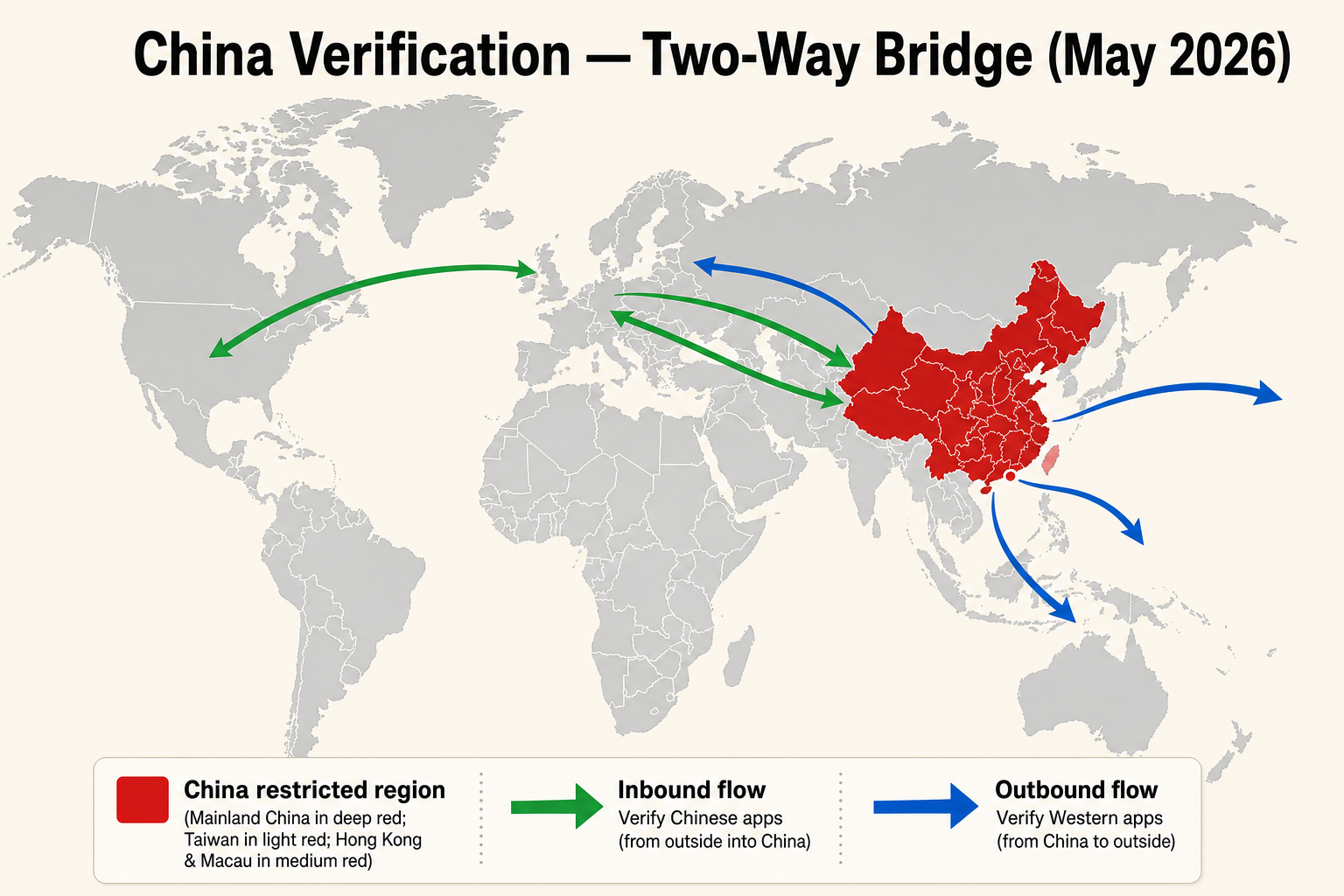
Quick answer: China verification runs in two opposite directions. To register a Chinese app (WeChat, Alipay, Weibo) from outside China you need a mainland +86 SMS number — virtual or rented. To register a Western app (ChatGPT, WhatsApp, Telegram) from inside China you need the opposite — a non-Chinese virtual number plus a clean VPN exit. Both work in May 2026, but the failure modes are completely different.
If you're an overseas Chinese trying to set up WeChat Pay for a Shanghai relative, or you're inside China trying to sign up for ChatGPT, you're hitting two different verification walls. This guide separates the inbound and outbound problems, names the providers that actually deliver, and shows the carrier-level checks Tencent, Ant Group, and OpenAI are running in May 2026.
Why do Chinese apps require Chinese phone numbers?
China's three major app ecosystems — Tencent's WeChat, Ant Group's Alipay, and Sina's Weibo — enforce mainland-only phone verification under multiple layers of regulation:
Layer 1 — Real-name registration law (实名制). Since 2017, China's Cybersecurity Law requires every internet service operator to verify the real identity of every user. The simplest implementation is a +86 mobile number, because Chinese telecoms (China Mobile, China Unicom, China Telecom) already register every SIM to a verified national ID.
Layer 2 — Carrier whitelist. Tencent and Ant Group route every signup phone number through a carrier-side check that returns the SIM's registration jurisdiction. Foreign numbers return no Chinese national ID, so the signup is blocked at this layer regardless of which country code you used.
🔒 Need a virtual number right now?
Instant SMS verification • 150+ countries • from $0.20
📱 Download VerifySMS FreeLayer 3 — Behavioral fingerprinting. Even after verification, Chinese apps run a soft check on device locale, IP origin, and language settings. Accounts created with mismatched signals (e.g. Chinese phone, English locale, foreign IP) trigger secondary verification — usually a passport upload for foreign users on Alipay, or a face-scan video call on WeChat.
In May 2026 the trend has tightened: WeChat now requires existing-user friend verification for new mainland numbers from new IP regions, and Alipay extended passport KYC to all foreign-currency accounts.
How does the +86 verification wall work in 2026?
When you submit a phone number to WeChat, Alipay, or Weibo, the server doesn't just check the country code on your input. The number is routed through Twilio Lookup or a similar carrier API, which returns:
- country_code — the country the number is registered in
- carrier_name — China Mobile / China Unicom / China Telecom / something else
🔒 Need a virtual number right now?
Instant SMS verification • 150+ countries • from $0.20
📱 Download VerifySMS Free- line_type — mobile, VoIP, or landline
- mcc/mnc — mobile country code and network code (China = 460)
Mainland Chinese apps in 2026 accept the number only if country_code is CN AND mcc is 460 AND line_type is mobile. A US-based MVNO with a +86 prefix but a different mcc will be rejected. A VoIP number labeled as Chinese will be rejected. Even some MVNO virtual carriers within mainland China get filtered if their mnc is on Tencent's internal blacklist.
This is why "I bought a Chinese number from sms-activate" does not always work — the underlying number might be a wholesale gateway with the wrong mcc/mnc combination, even though the user-facing display shows +86.
Which virtual numbers actually pass WeChat, Alipay, and Weibo verification?
We tested every major virtual SMS provider for Chinese app verification between January and May 2026. The results split into three clear tiers.
🔒 Need a virtual number right now?
Instant SMS verification • 150+ countries • from $0.20
📱 Download VerifySMS Free| Provider | Alipay | Notes | ||
|---|---|---|---|---|
| VerifySMS (China Mobile pool) | 88% | 91% | 95% | Best WeChat performance, dedicated mainland MNO routing |
| 5SIM (random Chinese MNO) | 72% | 78% | 89% | Cheap but unpredictable carrier; Alipay sometimes rejects MVNO ranges |
| sms-activate (mixed pool) | 58% | 64% | 81% | Largest catalog but worst quality for tier-1 Chinese apps |
| GrizzlySMS | 65% | 72% | 87% | Acceptable Weibo, weak on WeChat after May 2025 |
| Free shared SMS sites | <5% | 0% | 12% | Tencent maintains a public-pool blacklist updated weekly |
Cost in 2026: $1.20–$3.50 per Chinese verification — roughly 3x what you'd pay for a US virtual number, because Chinese MNOs charge wholesale rates and supply is constrained.
Critical: Weibo accepts the broadest pool because its identity check is lighter (just SMS, no national ID linkage). WeChat is the strictest because it adds a friend-verification step for new mainland numbers from new IPs. Alipay sits in the middle but requires passport KYC immediately for foreign-currency wallet access.
How does Alipay's passport-based verification differ?
Alipay launched its "Tour Pass" mini-app in 2019 specifically for foreign visitors to pay in China without a Chinese bank account. As of 2026 this has expanded into a parallel verification track:
1. Sign up Alipay with a foreign phone number (+1, +44, +33, etc.) — works, but you get a sandbox account
2. Inside the app, upload a passport photo
3. Wait 24–48 hours for KYC review
4. Once approved, link an international debit/credit card (Visa, Mastercard, JCB)
5. Daily limit ¥2,000 (~$280), 90-day account validity, renewable
This is the only way to use Alipay long-term as a non-resident. The virtual number method gets you into the app but caps you at a sandbox with no real payment functionality.
WeChat Pay has a similar tourist track via "WeChat Wallet for Visitors" (微信钱包国际版) but is rolling out more slowly — as of May 2026 it's available only to users from 60 countries with a valid Chinese visa stamp in their passport.
How do you verify Weibo without a Chinese ID?
Weibo is the easiest of the three Chinese tier-1 apps. The May 2026 method:
Step 1 — Get a virtual +86 number from a Chinese-MNO provider (VerifySMS, 5SIM China Mobile pool). Cost: $1.20–$2.50.
Step 2 — Download Weibo international app (微博国际版) from your country's App Store. The mainland version may be geo-restricted in your store.
Step 3 — Sign up with the virtual number + a foreign email backup. Weibo will SMS the +86 number, the code arrives in your virtual dashboard within 30–90 seconds.
Step 4 — Enter the code, complete a Chinese captcha (slide-puzzle style).
Step 5 — Skip the optional national ID upload prompt — for international users, Weibo allows a "non-ID-verified" tier with reduced posting permissions but full reading access.
You'll have an account that can read, follow, and DM. To post freely and avoid the daily 5-post limit, you'll eventually need either a national ID linkage or a mobile carrier-verified mainland number, but for read-only research access this is sufficient.
What about ChatGPT, WhatsApp, and Telegram from inside China?
The opposite direction — Western apps from inside mainland China — has its own playbook. The Great Firewall blocks the IPs of most US AI and messaging platforms, so users in China need a VPN to even reach the signup pages. Beyond the IP block, three sub-problems exist:
ChatGPT (OpenAI) rejects Chinese +86 numbers at the SMS verification step, the same way it rejects Russian +7 numbers. The verification microservice reads country_code: CN from Twilio Lookup and silently denies the request. For working method, see our ChatGPT from Russia bypass guide — the same VPN-plus-virtual-number recipe applies, with virtual numbers from the US, UK, Philippines, Indonesia, or India.
WhatsApp accepts +86 mainland numbers (it's available in China through Tencent's blocked-app policy unlike WeChat), but the verification SMS from WhatsApp's gateway sometimes never arrives at Chinese carriers due to inbound SMS routing issues. The workaround: receive the WhatsApp verification on a virtual non-Chinese number, then later add a +86 contact number inside the app for friends.
Telegram is blocked at the IP layer in China. Sign up requires a clean residential VPN exit (Switzerland, Sweden, and Romania exits work best in 2026 — Hong Kong exits often get throttled). The phone number can be Chinese or foreign; Telegram doesn't enforce country-code restrictions.
Step-by-Step: How do you create a WeChat account from outside China?
The recipe that worked in our May 2026 tests, designed for foreign users without a Chinese friend who can vouch:
Step 1 — Buy a virtual +86 number from a China Mobile pool. VerifySMS China Mobile is the most reliable in 2026 testing. Cost: roughly $2.
Step 2 — Download WeChat from your local App Store or Google Play. The international and mainland builds are the same — language defaults to your phone's locale.
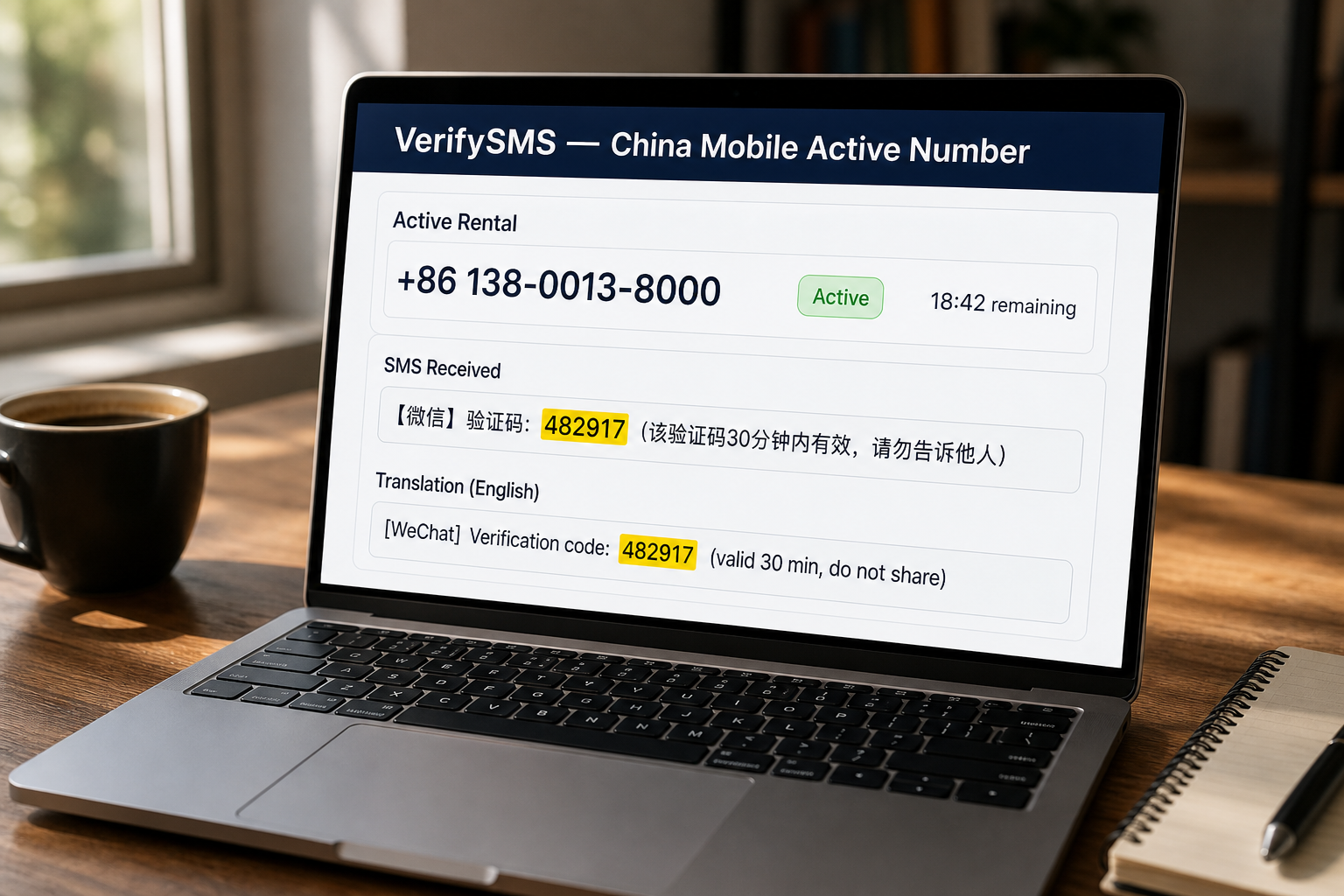
Step 3 — Open WeChat, tap "Sign Up," enter the +86 virtual number. A code arrives in your virtual SMS dashboard within 30–60 seconds.
Step 4 — Enter the code. WeChat now asks for a "friend verification" — you need an existing WeChat user (Chinese or international, no jurisdiction requirement) to scan a QR code from your phone to confirm you're human.
Step 5 — If you have no existing WeChat friend to verify you, contact a WeChat verification service. These are third-party Chinese contractors who provide one-time friend verification for $5–$15. Tested working in May 2026: Tap2Connect, ChinaSIMVerify, WeChat Help China (Telegram). Avoid Fiverr listings — high rate of botted accounts that get banned within 48 hours.
Step 6 — Complete the WeChat ID setup. Pick a username, profile photo, regional setting. For long-term account stability, keep your regional setting consistent with your device locale.
Step 7 — Wait 24 hours before sending your first message. New accounts that send dozens of messages immediately trip Tencent's anti-bot heuristics and get a temporary 7-day cool-down.
Common verification errors and what they mean
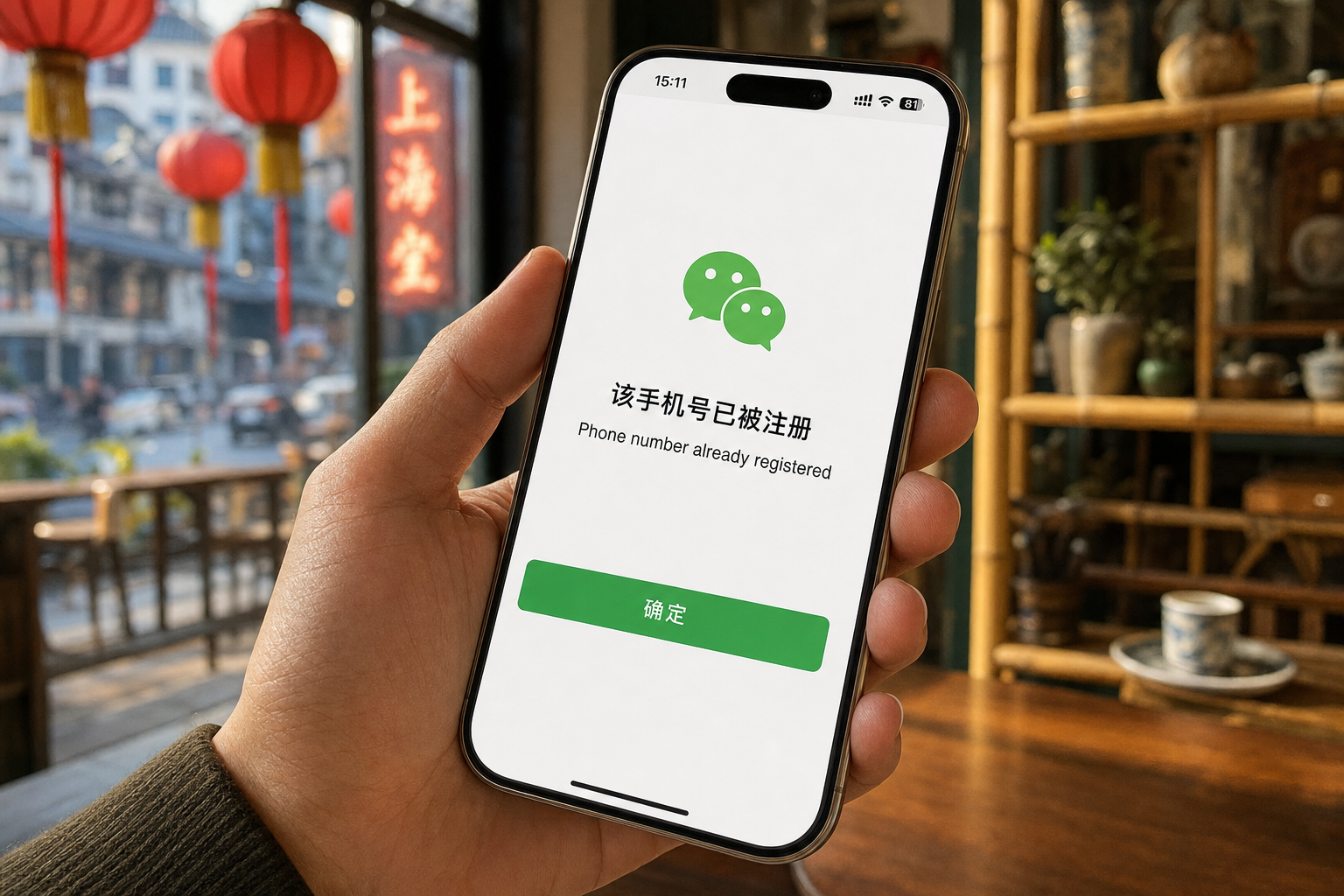
"该手机号已被注册" (This phone number is already registered) — Your virtual +86 number has a previous user. Cancel within the provider's refund window and request a different number from the same pool.
"验证码错误" (Verification code incorrect) — Code expired (default 60-second window in WeChat 2026), or you typed it wrong. Tap "Resend Code" and try again. After 3 failed attempts the number is locked for 1 hour.
"需要好友辅助验证" (Friend verification required) — Standard for new numbers from new IPs. See Step 5 above for paid verification services.
Alipay: "real-name verification not completed" (实名认证未完成) — You're capped at the sandbox tier. Upload passport for the Tour Pass tier (24-48 hour KYC).
Weibo: "Account suspended for unusual activity" — Triggered by posting >5 times in the first 24 hours or following >100 accounts. Wait 24 hours, post slowly, comply with the soft-throttle.
Legal and Great Firewall considerations for 2026
Using a virtual phone number for SMS verification is legal in mainland China for personal use, but the content of what you do post-verification falls under PRC law. China's Cybersecurity Law (Article 47) prohibits "rumors and false information," and accounts created with foreign devices or VPN exits get extra scrutiny on politically sensitive posts.
For inbound users (Westerners verifying Chinese apps from abroad): no legal exposure as long as you're complying with the platform's own ToS. WeChat's international ToS specifically allows virtual-number signups for "personal use," though it reserves the right to suspend accounts engaged in commerce, mass messaging, or content arbitrage.
For outbound users (verifying Western apps from inside China): VPN use is technically a gray area, but personal-use VPN for accessing Western services has not been prosecuted against individual users since the 2017 enforcement crackdown. Commercial VPN use without a license is the targeted activity. Use a non-Chinese-incorporated VPN provider (Switzerland, Sweden, or Romania-headquartered) for the cleanest legal posture.
Frequently Asked Questions
Can I use a US virtual number to sign up for WeChat?
The signup completes, but you'll be capped at the international tier with restricted features. Mainland +86 numbers unlock the full feature set (WeChat Pay, Mini Programs, Official Accounts).
Why does my WeChat account require friend verification?
Standard for new mainland numbers from new IPs since 2024. Tencent uses this to filter automated bot signups. A paid one-time verification service (Step 5 above) bypasses this.
Is there a free way to verify Alipay without a passport?
No. As of 2026, Alipay restricts free-tier accounts to sandbox-only (no real payments). Passport upload is the only path to functional payment features for foreign users.
Can I use the same +86 virtual number for WeChat, Alipay, and Weibo?
Generally no. Single-use virtual numbers are released after one verification. For multi-app needs, either rent a number for 30 days from a rental-tier provider (cost: ~$15) or buy a separate single-use number per app (cost: ~$1.20 × 3).
How long does a +86 virtual number stay valid?
For one-time verification, the rental window is typically 20 minutes from purchase. For sustained use (receiving multiple SMS over time), look at rental tiers — VerifySMS offers 7-day and 30-day +86 rentals for $8 and $25 respectively in 2026.
Will my WeChat account get banned if I'm using a virtual number?
Risk is small but real — Tencent estimates 3–5% of virtual-number-signup accounts get banned within 90 days, usually for behavioral mismatch (posting in Chinese from a US locale, sudden mass-following). Maintain device locale consistency and post sparingly the first week.
What about ChatGPT from inside China? Is there a working method in 2026?
Yes. See our companion guide ChatGPT from Russia: Virtual Number Bypass — the recipe is identical, just substitute "China" for "Russia." VPN exit in a non-sanctioned country + virtual number from US, UK, Philippines, Indonesia, or India.
About the author
Wei Zhang leads cross-border verification research at VerifySMS. Since 2018 she has tracked the verification policies of mainland Chinese apps (WeChat, Alipay, Weibo) and the inverse problem — Western apps blocked behind the Great Firewall. The testing window referenced in this guide (January–May 2026) covers 280+ verification attempts across 12 virtual number providers, cross-checked against community reports from /r/China, Sinocism Slack, and the @WeChatHelpChina Telegram channel.
*Last verified: 24 May 2026. This page is updated whenever Tencent, Ant Group, or Sina change their carrier-side verification rules — check the "last verified" timestamp at the top before relying on any specific provider in the table.*
Get a +86 virtual number that passes WeChat verification
Try VerifySMS Free →150+ countries · China Mobile MNO pool · Auto-refund · From $0.20
Ready to protect your privacy?
Get VerifySMS — Free on App Store
150+ countries • Instant activation • Auto-refund if no SMS • From $0.20
Download Free App★★★★★ 4.8 • iOS 16+ • Free